
Innovation Only Matters When People Trust It
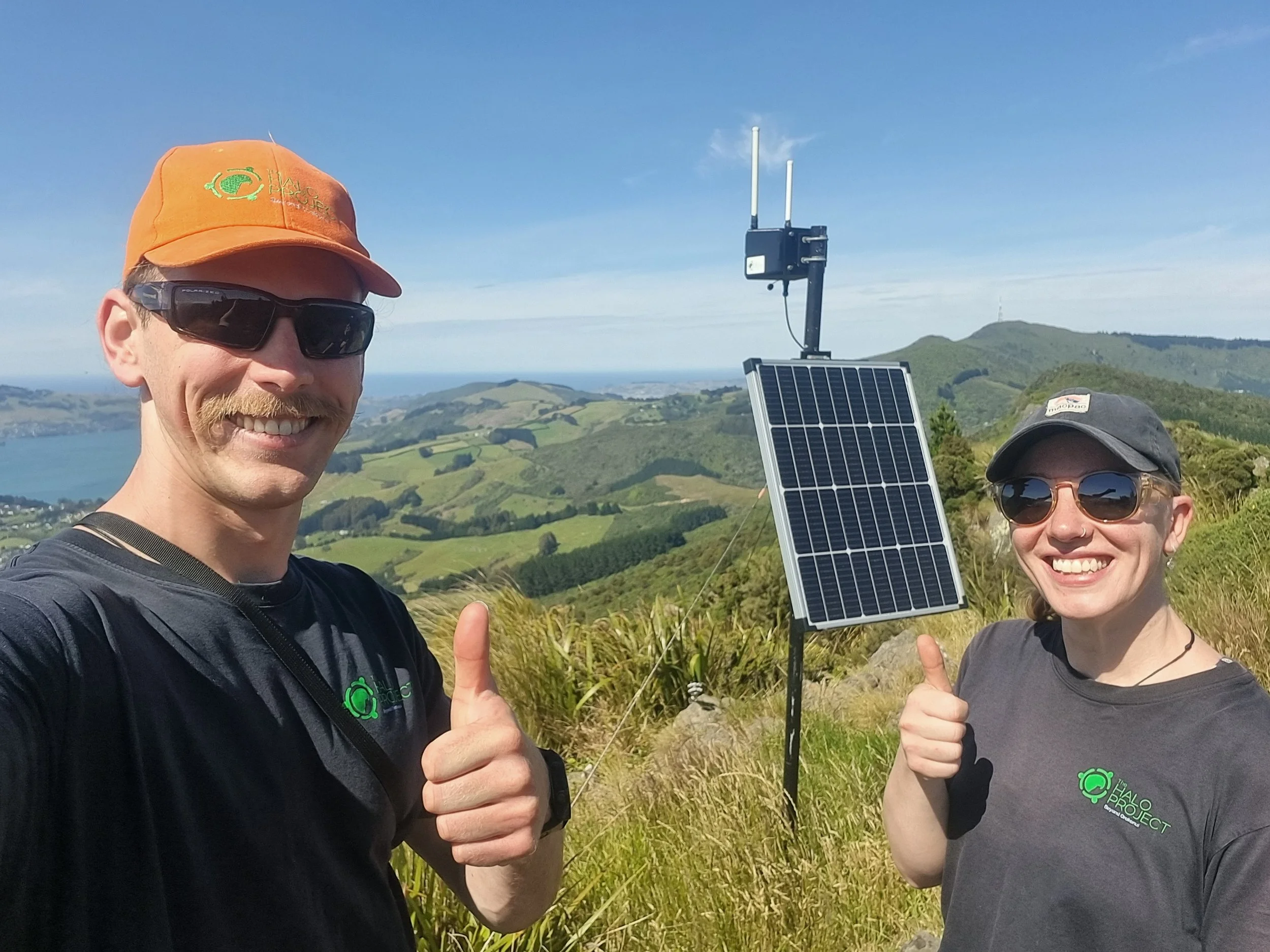
Kim and Abby from the Halo Project with an FTP trap at Mihiwaka Gateway.
At The Halo Project north of Dunedin, the most important moment in the rollout of the FTP smart trap network was not when the traps were installed, but when they were finally activated. The technology had already been developed: AI-enabled traps designed to arm only when a possum or rat was detected, supported by solar power, cameras and wireless monitoring. But the traps were deliberately left switched off while trust was built with mana whenua and other key stakeholders because of shared concern for kākā and other taoka species. That delay was not a sign of hesitation or failure. It was part of what made the innovation viable.
Evidence was central to that process. The consultation report recorded more than 1,700 interactions between kākā and FTP-enabled traps without a trap arming itself, helping show the technology could be used responsibly as well as effectively. The wider lesson is that trust does not sit off to the side of innovation as a communications task to deal with later. In environmental and community projects, it is part of the infrastructure that allows a new system to move from technical promise to real-world adoption.
Innovation is often framed as a technical challenge: build a better tool, generate better data, automate the system, and progress will follow. But environmental and community projects rarely work like that. The harder question is whether people trust a new approach enough to use it, support it and build it into decisions over time.
Across biodiversity, restoration and infrastructure projects, the strongest innovations are rarely adopted because they are novel. They are adopted because they are tested, interpreted and made credible in context.
There is a wider lesson in that. Organisations often treat engagement as something that follows innovation — a communication task to help people understand a new system after it has already been chosen. But engagement should be part of the innovation process itself, shaping the conditions under which a tool is seen as credible. In sectors where ecological risk, community values and public scrutiny all matter, that distinction is critical.
Whirika’s drone-dispersed seed pod work offers a different angle on the same story. Rather than treating drone delivery as inherently transformative, the project moved through staged trials, early growing results and field testing. That careful progression helped build confidence in what the method could and could not yet do.
Even projects that look less obviously innovative on the surface show the same dynamic. At Whakatāne District Council, outward-facing energy dashboards helped turn building and infrastructure performance into something transparent and actionable. The data is used as part of a bimonthly review by the Council’s Energy Action Group and has led to practical outcomes, including reduced gas and electricity use at the library and major electricity savings from high-efficiency pump replacement at the water treatment plant. What matters is not the dashboard’s visual appeal, but the way it builds trust in the data and makes progress visible. It becomes easier to act when people can see what is happening and connect interventions to outcomes.

Whakatāne District Council dashboard showing cumulative energy cost savings across its facilities.
Whirika’s work in Toitū Te Hakapupu / Pleasant River shows the same principle in water quality monitoring. The Aquawatch Waka, a floating automated water quality monitoring device, captured changes during dry periods and flood events that occasional sampling could miss. Used alongside lab samples, flow data, eDNA and ecological monitoring, it helped build a clearer picture of the catchment. That evidence was then shared through factsheets and community workshops, turning technical findings into practical messages people could understand and act on.
Taken together, these examples point to a broader idea. Innovation in sustainability is not just about invention. It is about adoption under real-world conditions — proving performance, accounting for risk, and showing how a new approach behaves in practice rather than theory.
For leaders, this has practical consequences. If you want a new system to stick, ask not only whether it is clever, but whether it is interpretable, monitorable and trusted by the people expected to rely on it. Ask whether stakeholders have seen enough evidence to support activation, whether end users have helped test its assumptions, and whether the benefits are visible enough to sustain confidence. These are not communications questions to consider after the fact. They are design questions from the beginning.
In a time when new technologies are arriving quickly, that kind of grounded innovation may matter more than speed alone.